Journal
3 October 2026
The city that refuses to arrive
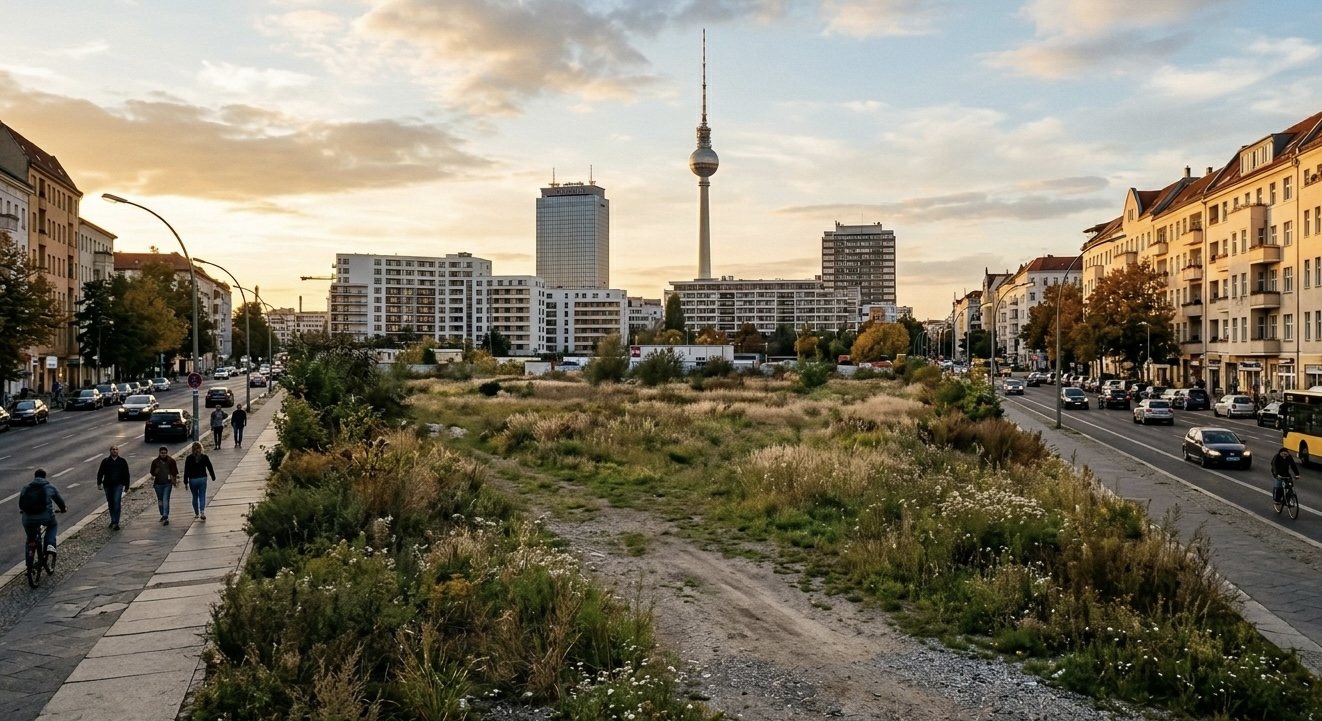
Berlin has a habit of refusing to finish its sentences. Spend time walking through the city and a pattern begins to emerge: an empty lot where you expect another building, a square that never quite resolves into a square. It is easy to read these places as scars, the residue of war and division. Spaces waiting to become something complete.
Karl Scheffler, an art critic and writer, saw something else. In 1910, decades before the Second World War, before the Wall, before Berlin acquired the history that seems to explain its gaps, he wrote that the city was “condemned ever to becoming, never to being.”
The incompleteness came first. The twentieth century didn’t create Berlin’s absences. War, division, the Wall coming down: each one confirmed what was already there.
Which changes what those leftover spaces mean. Architects have a name for them: terrain vague. Elsewhere they read as interruptions, gaps waiting to be resolved. In Berlin, they get inhabited instead of resolved.
Film director Wim Wenders understood this before most urbanists did. In his film, Wings of Desire, he turned the city’s gaps from backdrop into subject.
A circus camps on an empty lot near Friedrichstrasse, then packs up and leaves. The space falls silent again, waiting for whatever comes next. The camera lingers on the wasteland around the old Potsdamer Platz.
What these spaces offered was a kind of seeing through: through to the horizon, which buildings usually block, and through to what was, which the present usually crowds out.
This is what “becoming” looks like from ground level. The city admitting it isn’t finished, hasn’t decided, might still become something else.
A vacant lot can be a shortcut, a circus ground, a protest site, a place to sit in the sun, a place to imagine something else. It remains open because it remains undecided.
Development closes that question. Which is why Potsdamer Platz matters.
For decades it was Berlin’s largest and most symbolic void. Levelled by bombing, left as an unresolved space at the centre of the city. Wenders had already filmed it this way. In Wings of Desire, an old man wanders the wasteland searching for the square he remembers from before the war. By then it exists only in memory.
After reunification, the square began to close. Lawns went in first, then glass. By the usual measure, this was a triumph. By Scheffler’s measure, something closer to a betrayal. Wenders watched the lawns go in and said it plainly: it used to be a kind of wilderness. Now it was nothing.
The director had become his own character. The old man was mourning a square he remembered from before the war. Wenders was mourning the wasteland itself, the one place left where you could still see through to what it had been.
The rebuilt square is perfectly legible. It tells you where to go, what to do there. There’s nothing left to interpret.
It isn’t that Berlin lost a place. It lost a question.
Not every city gets to ask it twice.
Also published on Resonanz Journal on Substack.
← Journal